

What Is a Cataract?
A cataract is the loss of transparency of the eye’s natural lens, which sits just behind the pupil. While cataracts most often develop as a natural part of ageing, they can also be congenital or arise from trauma or certain medications. In addition, in systemic diseases such as diabetes, cataracts may appear at a younger age.
What are the symptoms of cataract?
Symptoms vary depending on the type of cataract. The most important sign is reduced vision, which is most easily noticed when one eye is covered. Patients may experience discomfort from bright lights at night, difficulty reading and reduced vision either in darkness or in sunlight. Some cataracts cause a temporary “pseudo-myopia,” in which distance vision worsens while near vision temporarily improves, only to deteriorate again later. Colours appearing washed-out or yellowed is another typical finding.
How is cataract treated?
The only definitive treatment for cataract is surgery. There is no medical treatment available.
Once a cataract has started to develop there is no medical therapy that can reverse the process. The procedure is therefore to remove the lens that has lost its transparency and replace it with an artificial intra-ocular lens.
- Toric lenses
- Multifocal lenses
- EDOF lenses

1. Toric lenses: Astigmatism is a refractive error caused by the shape of the eye that disturbs both distance and near vision.
Studies show that around half of patients in the cataract age group also have astigmatism that needs correcting.
Standard intra-ocular lenses cannot correct astigmatism, but toric lenses correct it permanently, which usually eliminates the need for distance glasses after surgery.
2. Multifocal lenses (premium / “smart” lenses):
These lenses are designed to provide both distance and near vision.
Up to a certain age, our natural lens has the ability to “accommodate” — to change its focusing power according to distance.
From around age 40–45, this ability gradually decreases and reading glasses become necessary.
This condition, known as presbyopia (“ageing eye”), is, as the name suggests, a natural part of getting older. Excimer laser treatments, although highly successful in other areas, do not provide a permanent solution for presbyopia.
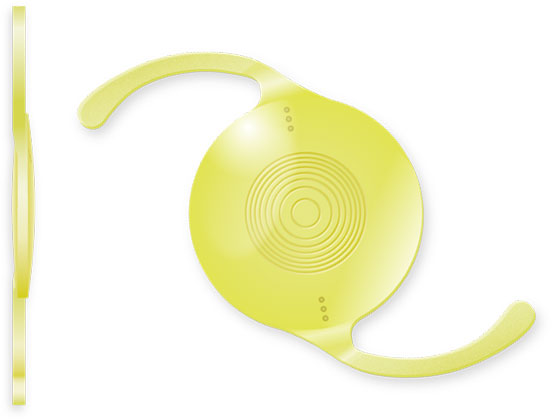
Efforts to manufacture truly accommodative intra-ocular lenses — lenses that mimic the natural lens by focusing near and intermediate distances through the action of the eye muscles — continue at full speed, but the ideal solution has not yet been achieved.
For that reason, near vision is currently provided through different optical principles and lens designs. After 20 years of development in multifocal lens technology, today the most widely preferred option is the diffractive trifocal lens. Diffractive bifocal lenses, which do not provide good intermediate vision, are no longer used.

For trifocal lens implantation the eye’s anatomy must be suitable, and there must be no other significant pathology that could limit vision — advanced glaucoma or macular disease, for example.

3. EDOF lenses (Extended Depth of Focus):
EDOF lenses provide a continuous range of vision from distance to intermediate and also contribute to near vision. Their near-vision performance is somewhat lower than that of trifocal lenses. Several different optical designs are used:
- Pinhole
- Spherical aberration | Pure EDOF
- Low-add diffractive lenses
- Hybrid lenses: EDOF + low-add diffractive
- Increased power in the central zone, or wavefront modulation
The most widely used EDOF lenses today are those based on wavefront modulation and spherical-aberration designs. Their main advantage over trifocal lenses is a marked reduction in contrast loss and in the light reflections known as “photic phenomena”. EDOF lenses can be a good choice for active working-age patients, for patients who have previously undergone refractive surgery and for those whose ocular anatomy is not suitable for trifocal implantation.
Patients implanted with EDOF lenses do not generally need glasses for most everyday activities, although low-power reading glasses may still be helpful for prolonged reading or in dim lighting.
Important considerations with premium / “smart” lens applications
Premium lenses are currently the only permanent solution for presbyopia, the loss of near vision that appears after a certain age. For this reason, patients — especially those over 50 — who wish to free themselves from glasses are offered lens exchange instead of excimer laser. When the natural lens is changed in the absence of cataract, the procedure is called refractive lens exchange.
Refractive cataract surgery or refractive lens exchange is essentially an elective, aesthetic procedure. As with any elective procedure, the decision must be made by the patient, not by the surgeon. The surgeon’s role is to inform the patient correctly and to perform the surgery to the highest standard.
Which patient should receive a trifocal lens and which an EDOF lens is also one of the most debated questions among surgeons today. The decision depends on whether a cataract is present, on the characteristics of the eye, on the patient’s occupation and on their expectations.
Implanting a near-vision lens has certain prerequisites. In simple terms, if the eye has any problem other than a refractive error or cataract, premium lenses should not be implanted. Macular degeneration, diabetic retinopathy, severe dry eye, corneal dystrophies, keratoconus, optic neuropathy and advanced glaucoma are examples of conditions in which premium lenses should be avoided.
If the eye is suitable, your surgeon will perform multiple calculations to determine the correct lens power. If your astigmatism is above a certain level, a toric lens should be preferred — the most common cause of patient dissatisfaction after surgery is residual refractive error.
Because the implanted lens will remain in the eye for life, the quality of its material is extremely important. After both trifocal and EDOF lens implantation the refractive result is permanent: no further cataract develops, and over time the need for glasses neither increases nor decreases. Even so, an annual eye examination is recommended in order to monitor general eye health.
In summary, many factors can influence the outcome of premium lens surgery. In appropriately selected patients, optimally performed surgery leads to excellent results and high patient satisfaction.
Early diagnosis is essential in all eye conditions. At least one eye examination per year is recommended.
Prepared by the Editorial Board of Eye Foundation Hospitals.