
What Is Strabismus?
Strabismus is the loss of parallel alignment between the two eyes. Each eye has six extra-ocular muscles. If one or more of these muscles is over- or under-active, the eyes can drift out of alignment. While one eye looks straight, the other may turn inwards, outwards, upwards or downwards. In some cases the deviation is present in both eyes.
Depending on the cause, the deviation can be constant or intermittent. Strabismus affects approximately 4% of the population, and it occurs equally often in boys and girls.
What Are the Symptoms of Strabismus?
- Loss of alignment between the eyes.
- Pain or watering in the eyes,
- Double vision, blurred vision, loss of three-dimensional perception,
- A head turn or tilt to one side, chin-up or chin-down posture, looking up while bending the head down.
What Are the Symptoms of Strabismus in Adults?
- The most common symptom of strabismus appearing in adulthood is double vision.
- Pain in the eyes, headache and constantly tilting the head are also common.
- Children and adults with an outward deviation tend to close one eye in bright sunlight.
What Are the Risk Factors for Strabismus?
- A family history of strabismus,
- Premature birth,
- Febrile convulsions in early childhood,
- Consanguineous (related) parents,
- Trauma (a fall from height or a head injury),
- A complicated pregnancy.
What Are the Diagnostic Tests for Strabismus?
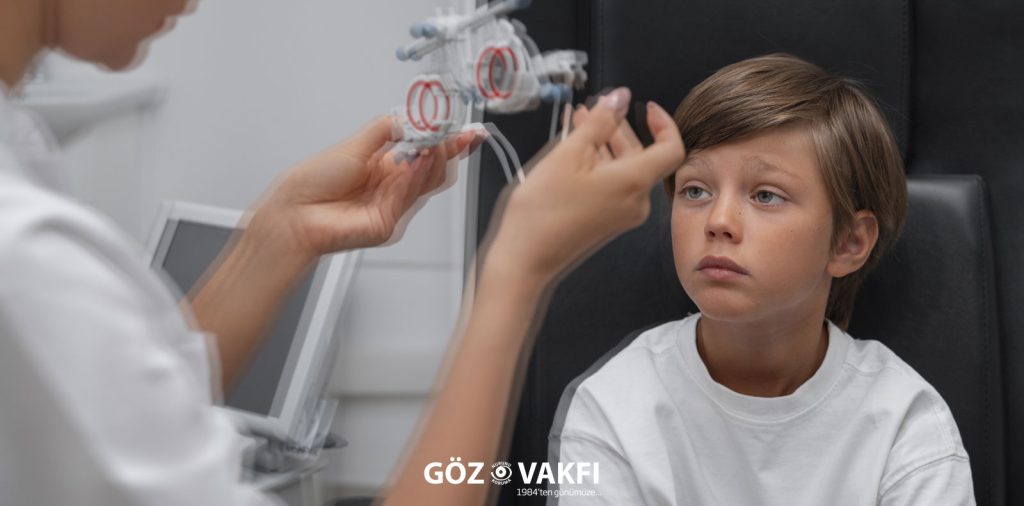
- Evaluation of vision. At our hospital, a dedicated paediatric refraction unit (Plus Optix device) is used for children aged 6 months to 4 years.
- Direction of the deviation and when it began,
- Measurement of the angle of deviation using prisms and the synoptophore,
- Hess screen test: important in strabismus caused by extra-ocular muscle palsy,
- Hirschberg test: assessment of the angle of deviation using the corneal light reflex in patients unable to fixate,
- Stereopsis test: assessment of depth perception (three-dimensional vision).
Early Diagnosis in Childhood
It is very important that the first eye examination is performed by the age of 1 at the latest;
- Ptosis (drooping eyelid) and nystagmus (involuntary eye movements) can be diagnosed and treated at this stage.
- Congenital cataract, congenital glaucoma and retinal disorders can cause permanent loss of vision within 2–3 months if not detected.
- An examination between 6 months and 1 year is particularly important for detecting and treating strabismus. Any deviation that persists after 6 months requires treatment.
- Even if there are no complaints, routine examinations at 3–4 years of age and again before school are important.
How Is Strabismus Treated?
- Optical treatment: Some types of strabismus are caused by a refractive error and can be corrected with glasses.
- Orthoptic exercises: Used to improve binocular vision and depth perception.
- Medical treatment: Treatment with mydriatic and miotic drops.
- Surgical treatment: The aim is to correct the deviation, restore binocular single vision and provide a good aesthetic appearance.
Surgery is used in congenital deviations and in deviations that develop later and cannot be corrected with glasses.
How Is Adult Strabismus Treated?
- Eye exercises: Used for conditions such as convergence insufficiency — eye strain when reading or working.
- Prism glasses: Used for small deviations. They help reduce double vision.
- Injection (Botulinum toxin): A drug that paralyses the injected muscle for several months. Useful in selected cases.
- Surgery: The most commonly used treatment at any age. In suitable patients it can be performed under local anaesthesia. Surgery may be carried out for cosmetic reasons, to reduce double vision, to enable both eyes to work together, or to reduce eye pain.
What Is Amblyopia (Lazy Eye)?
Amblyopia, commonly called “lazy eye”, is a reduction of 20% or more in visual acuity in one or both eyes. It occurs in 2–4% of the population.
Vision is a skill that the brain learns from birth onwards. If, for any congenital or acquired reason (cataract, strabismus, high refractive error, etc.), visual input cannot reach the brain properly, amblyopia can develop during the early years when vision is developing rapidly. Preventing amblyopia and establishing binocular vision (the use of both eyes together) is especially critical in the first two years of life, when the nervous system is still flexible. The earlier treatment starts, the better the result. Children with a family history of amblyopia or strabismus must have a complete eye examination by an ophthalmologist before the age of 3. Even in the absence of any symptoms or risk factors, every child should have a routine eye examination by an ophthalmologist by the age of 3–4 at the latest.
How Is Amblyopia Treated?
The first step in the treatment of amblyopia is to address the underlying cause. Conditions that obstruct vision — such as ptosis or cataract — must be treated first. Other treatment options include:
- Glasses: Refractive errors, which are often the cause of amblyopia, should be corrected with glasses or, if necessary, contact lenses. In most cases this basic approach is sufficient.
- Occlusion therapy (full or partial patching): The good eye is patched for full or part of the day. Recent studies have shown that in the 3–7 age group, 6 hours of patching for severe amblyopia and 2 hours for mild-to-moderate amblyopia is usually sufficient. Performing near-vision activities during the occlusion period increases the success of treatment. In general, children respond well to occlusion up to the age of 12.
- Penalisation therapy: Either atropine or optical penalisation. One drop of 1% atropine is applied to the good eye each morning, either every day or 2–3 days per week. The refractive error of the amblyopic eye is corrected as best as possible (sometimes with an added plus lens to improve near vision), while the good eye is intentionally under-corrected.
- CAM treatment: Applied in hospital, every day of the week, for 10 sessions. It is also offered at our hospital. Studies have shown that CAM treatment provides similar visual results to standard patching and near-vision activities.
Until What Age Should Amblyopia Treatment Continue?
Even when full vision is achieved in both eyes, amblyopia can recur after treatment is stopped. Children with amblyopia should therefore be followed up until the age of 10–12 and, if necessary, receive maintenance therapy to preserve the vision they have gained.
What Is Watering of the Eye and Tear Duct Obstruction?
The most common cause of watering and discharge in the eye is obstruction or stenosis of the tear duct. When pressure is applied at the root of the nose, inflammatory fluid can be expressed from the opening on the eyelid. In the first year of life this can be distressing for parents, but the duct generally opens spontaneously by the end of that year and the symptoms resolve. During this period, massage of the lacrimal sac at the root of the nose is recommended, together with antibiotic drops when discharge is present.
If the duct has still not opened by the age of 1, a procedure called probing can be carried out under general anaesthesia. If this is not successful at the first attempt, it can be repeated. If the duct still does not open, surgical intervention is required after the age of 3–4.
You can contact our hospital with any questions about eye health, obtain detailed information about your eye problems and learn about the treatment process.
Prepared by the Editorial Board of Eye Foundation Hospitals.