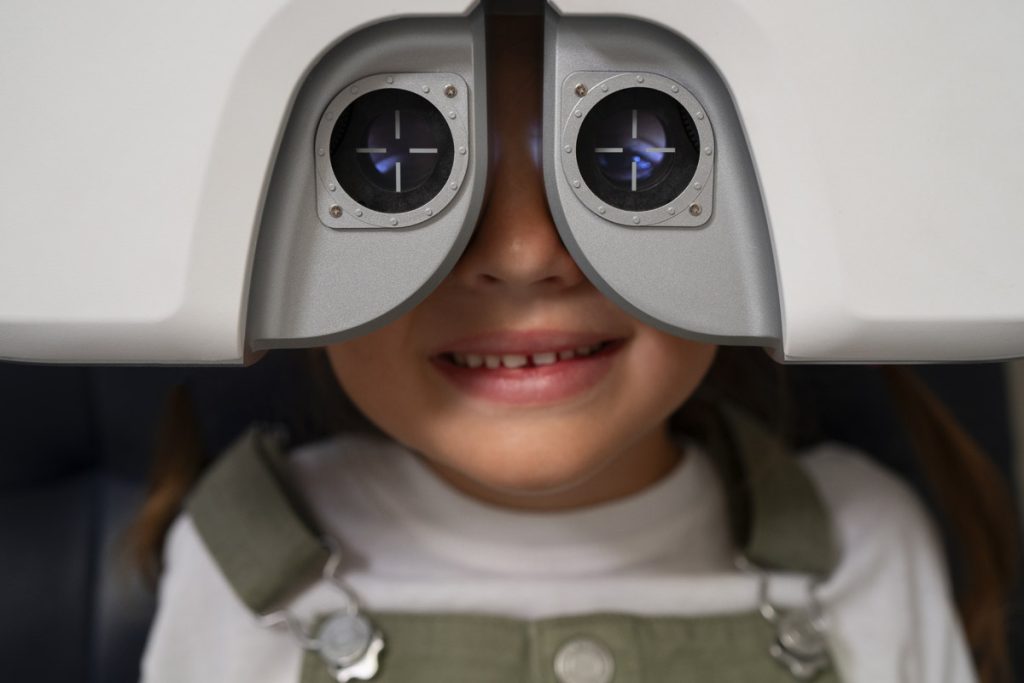
Vision disorders affect one in 20 children in the preschool period, and one in 4 children of school age…
The sense of vision begins to develop in the 3rd–4th months after birth and is completed at around 7–10 years of age. Because young children in particular cannot describe their complaints clearly, certain eye conditions may go unnoticed and lead to permanent visual damage later in life.
Parents are advised to be alert to certain signs and to take their children for an eye examination…
To speak of the signs:
Are the eyes parallel to each other when looking straight ahead, or while one eye looks straight does the other deviate inward, outward, downward or upward? Conditions such as turning or tilting the head to one side when watching TV or reading, closing one eye, blinking, squinting, rubbing the eyes, writing crookedly, skipping lines, looking at things up close, headache, frequently tripping and falling — these should make families suspect an eye problem.
These signs may be the result of refractive errors such as myopia, hyperopia and astigmatism (conditions requiring glasses), or may arise from amblyopia, strabismus, congenital or developmental cataract, hereditary corneal or retinal diseases.
The conditions we have described do not always show the signs we have listed above. Latent strabismus, amblyopia, developmental cataracts, corneal degenerative diseases, keratoconus and certain hereditary retinal diseases may give no warning signs to the family. These conditions, which can only be diagnosed through a detailed eye examination, can be treated before they have the opportunity to cause permanent damage.
In the absence of any complaints, we recommend an examination by a doctor within the first year (at 6–8 months), at 18 months, at 3, at 5 and particularly when starting school, between the ages of 7 and 8 (preschool).
Especially in this period before schools open, let us not neglect our children’s eye examinations even if there are no complaints.
Prepared by the Editorial Board of the Eye Foundation Hospitals.