
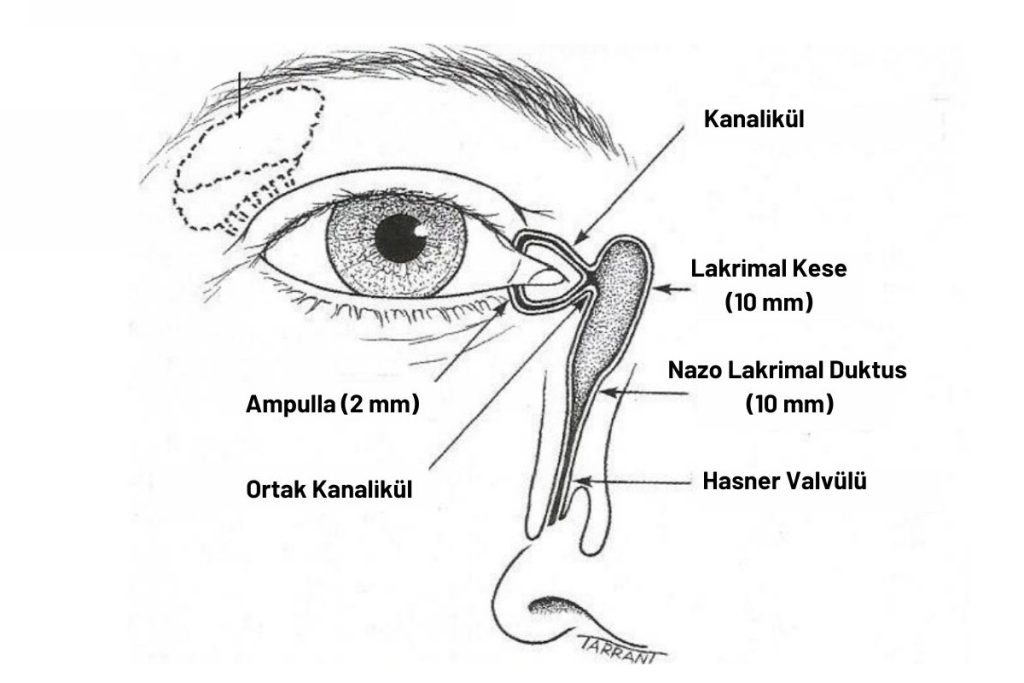
The tear duct is a system of water channels that begins at what is called the corner of the eye and ends behind the nose. This duct system carries away microscopic particles and microbes that reach the eye from the outside, ensuring that there is always a transparent, clean layer of fluid in front of our pupil. In other words, the tear ducts are the drainage system for our eye’s waste water.
Obstructions of this duct can occur for various reasons. If the duct system is not fully formed at birth, or has formed but has not completed its development, there will be constant watering and discharge from the eye from birth. At later ages, this drainage channel can also become blocked due to accidents, infections and various diseases. When it becomes blocked, the tears flow continuously outwards onto the cheek, as though the person were crying. If an infection also develops and becomes chronic, there will be a continuous inflammatory discharge. The acute inflammatory phase is painful, but in chronic inflammation there is generally not much pain. In the acute phase, if the patient consults a doctor, the inflammation can be cured with medication and the patient can be spared from blockage of the duct. However, in those who present late, medical treatment is no longer effective and surgery is required.
The tear duct is not a straight tube. Obstructions can occur at different levels, from the inlet to the outlet. Depending on the location of the obstruction, different operations are required to clear it. These operations are highly successful, but the patient must be examined by oculoplastic specialist doctors to determine the level of the obstruction and what type of surgery is required. For example, in obstruction at the first entrance, fitting a simple stent may be sufficient, while in more advanced obstructions, temporary silicone moulds — called tubes — can be placed. If the entire duct system is so severely closed that it cannot function, a new channel can be opened and permanent tubes inserted. Let us not forget that, as with every disease, early diagnosis and treatment are important.
Prepared by the Editorial Board of the Eye Foundation Hospitals.