
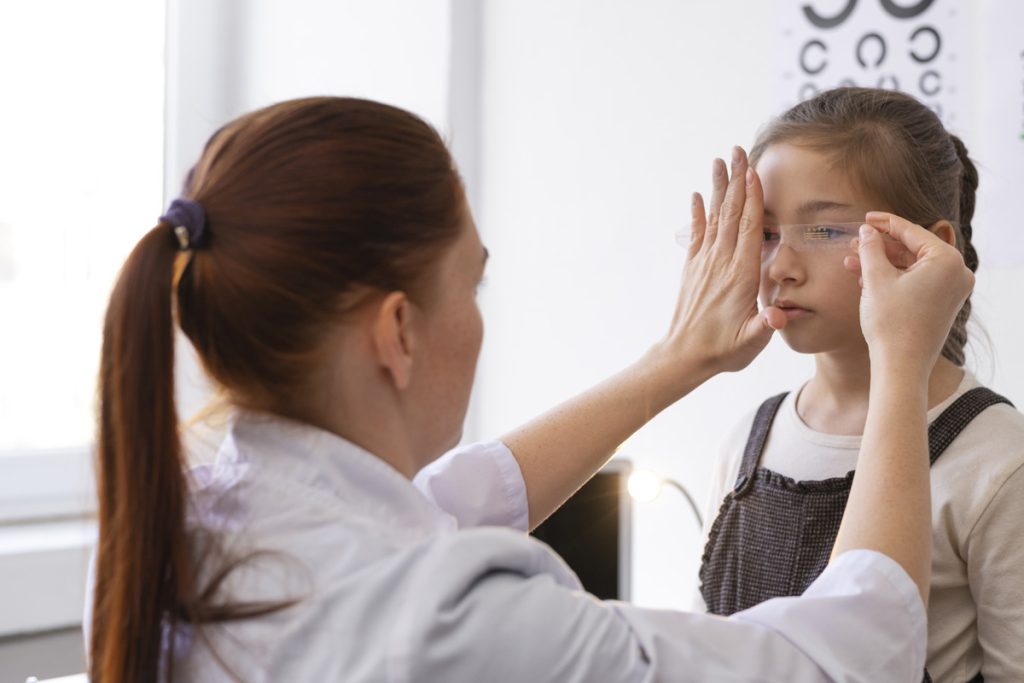
Why Do Our Children Need a Comprehensive Eye Examination Before Starting School?
For a child to succeed at school, many skills are required, and good vision is the key.
Throughout their education, children face increasing demands on their visual abilities. The font in textbooks gets smaller, and the time spent reading and studying increases significantly. The greater workload and homework place a significant burden on the child’s eyes. For children to be able to learn effectively and succeed, their vision must be of high quality and complete.
Healthy vision is linked to success in the classroom and beyond.
Vision problems are not isolated issues. They affect almost every aspect of a child’s development — from academic achievement and sporting activities to social interaction and the process of building self-confidence. However, without a comprehensive eye examination by an ophthalmologist, many vision disorders may go undetected, or — worse still — be misdiagnosed as Attention-Deficit / Hyperactivity Disorder, dyslexia, learning difficulties or behavioural problems. These misdiagnoses can then carry over into adulthood and further affect the individual’s level of education, employment opportunities and social interactions.
Visual skills required for school
Vision is more than the ability to see clearly or to have 20/20 sight. It is also the ability to understand and respond to what is seen. There are many basic visual skills beyond clear vision that are important for supporting academic success.
For effective reading and learning, every child needs the following visual skills:
- Visual acuity — the ability to see clearly at distance for the blackboard, at intermediate distance for the computer and at near for reading books.
- Eye focusing — the ability to maintain clear vision quickly and accurately as the distance to objects changes. For example, being able to focus on the notebook/book on the desk in an instant after looking at the blackboard.
- Eye tracking — the ability to keep the eyes on target when looking from one object to another, when moving the eyes along a printed page, or when following a moving object such as a thrown ball.
- Coordinated work of the eyes — the ability to coordinate and use both eyes together while moving them across a page, and to judge distances and see depth for class work and sports.
- Eye–hand coordination — the ability to use visual information to track and guide the hands when drawing or trying to hit a ball.
- Visual perception — the ability to organise the images on a printed page into letters, words and ideas, and to understand and remember what is read.
If any of these visual skills are absent or not working properly, the child will have to work harder to learn effectively. A child may not tell you that they have a vision problem because they may think that their own vision is the way everyone sees. Students struggling with a vision problem related to learning may experience headaches, eye fatigue and physical tiredness. Parents and teachers should be alert to signs that may indicate a child has a vision problem.
Signs of eye and vision problems:
- Complaints of discomfort and fatigue.
- Frequent eye rubbing or burning and itching.
- Short attention span.
- Avoiding reading and other near-work activities.
- Frequent headaches.
- Covering one eye.
- Tilting the head to one side.
- Holding reading materials close to the face.
- An eye that turns in or out.
- Double vision.
- Skipping lines when reading.
- Difficulty remembering what was read.
Why are back-to-school eye examinations important?
Because vision can change frequently during the school years, children should have an eye examination every year — or more often if there are specific problems or risk factors, or if recommended by an ophthalmologist. The most common vision problems in school-age children are refractive errors caused by myopia (inability to see distance), hyperopia (inability to see near) and astigmatism (which causes blurred vision). However, a child who can see clearly and has full vision may still have vision problems related to eye focusing, eye tracking and eye coordination.
Fortunately, there is an easy way to ensure your child’s healthy vision and overall eye health:
Schedule a face-to-face, comprehensive eye examination with an Ophthalmologist as part of your annual back-to-school routine.
I wish all our children and young people a healthy and successful school year. With my best wishes that the light in our children’s eyes never fades.
Dr. Mehmet Bülent Doğu
Eye Foundation Bayrampaşa Eye Hospital
Prepared by the Editorial Board of the Eye Foundation Hospitals.