
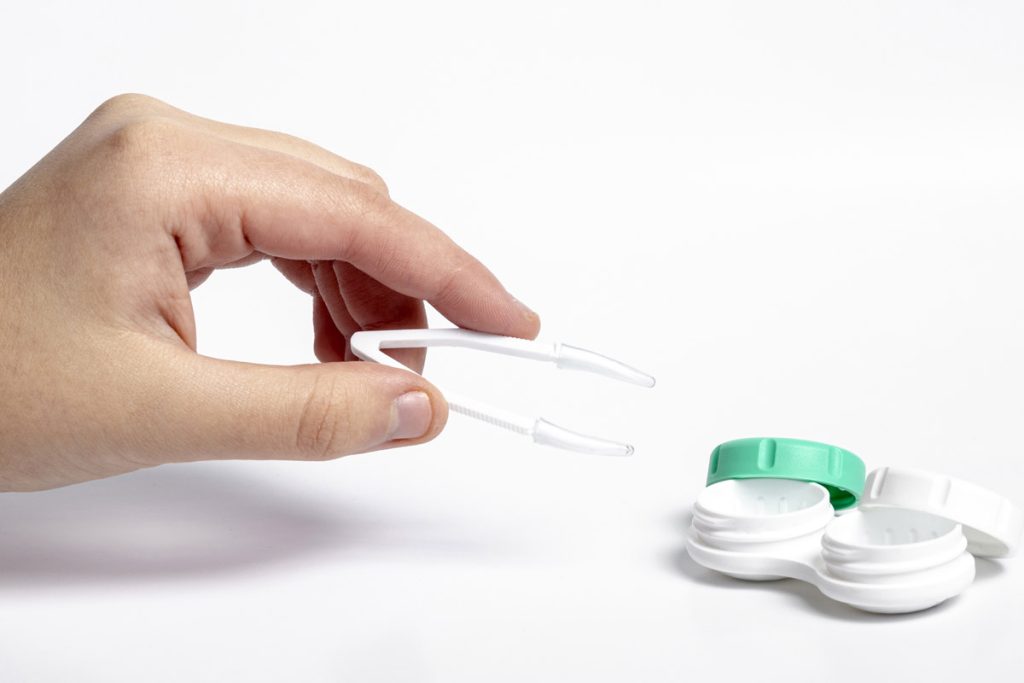
Contact lenses are devices that replace glasses, make our lives easier and give us freedom. Because they eliminate many of the inconveniences of glasses while on holiday and during sports, they are very popular among young people and those who feel young. Particularly during the pandemic, when the masks we had to wear caused our glasses to steam up, the use of contact lenses has further increased.
Contact lenses are grouped into three broad categories: soft, gas-permeable rigid and scleral. Soft lenses correct refractive errors such as myopia, astigmatism, hyperopia and presbyopia (near-vision disorder). There are many different brands of contact lenses produced today by various manufacturers. Just as each person’s corneal (transparent) layer is as unique as a fingerprint, the diameter and base curve of each lens differ. For this reason, contact lenses must be obtained only after a doctor’s examination. Once the prescription is determined, a trial lens is placed on the patient’s eye and kept there for a while. The movement of the contact lens on the eye is evaluated. A tight lens adheres to the eye and causes redness and the formation of new vessels due to nutritional impairment. A loose lens, on the other hand, moves too much and irritates the eye.
In addition, in people with astigmatism, the alignment between the astigmatic axis of the eye and the astigmatic axis on the lens must be evaluated for the sake of visual quality. After the doctor determines the appropriate lens, they will issue a prescription specifying all its features, including the brand name. It is legally required for contact lenses to be obtained with a prescription that specifies the brand suited to the individual, and for the seller to provide the brand stated on the prescription.
Gas-permeable rigid and scleral contact lenses are used in cases such as keratoconus, and in situations such as injury where the surface of the cornea has lost its smoothness.
Soft lenses are produced as daily disposables, 15-day and monthly lenses. However, 15-day and monthly lenses are not kept in the eye throughout that period — they are removed every evening and cleaned. Our eyes are exposed to microbes, and contact lenses come into direct contact with the eye. For this reason, the rules must be followed very carefully when wearing contact lenses. Before putting on and taking off lenses, hands should be washed with soap and water for at least 20 seconds and dried with a lint-free towel. Whatever the type of lens, it must always be removed in the evening and kept in a special lens solution. In the morning, after the lenses are put in, the solution in the lens case should be emptied, the case turned upside down on a piece of paper towel, and fresh solution placed in the case before the lenses are removed each evening. The lens case comes inside the bottles of solution; with each new bottle of solution, the old case should be discarded and the new one used. Make-up should be applied after the lenses are put in and removed after the lenses are taken out. In addition, you should not enter the shower, sea, swimming pool or sauna while wearing contact lenses. If the rules are not followed when wearing contact lenses, problems that can extend to vision loss may be encountered.
For a video on the correct use of contact lenses prepared by the Contact Lens Unit of the TOA (Turkish Ophthalmological Association), you can scan the QR code below.
Even if contact-lens users have no complaints, they must have an eye examination every 6 months or once a year as recommended by their doctor. When the rules are followed and regular check-ups are kept, it is possible to wear contact lenses for many years without any complaints.
Prepared by the Editorial Board of the Eye Foundation Hospitals.