What Is ‘Laser Eye Correction’?
The treatment of refractive errors with excimer-laser photoablation is known in everyday language as “having the eye etched”.
For which conditions is excimer-laser correction used?
Excimer laser can be used to treat myopia, hyperopia and astigmatism up to a certain level.
Types of excimer-laser eye surgery;
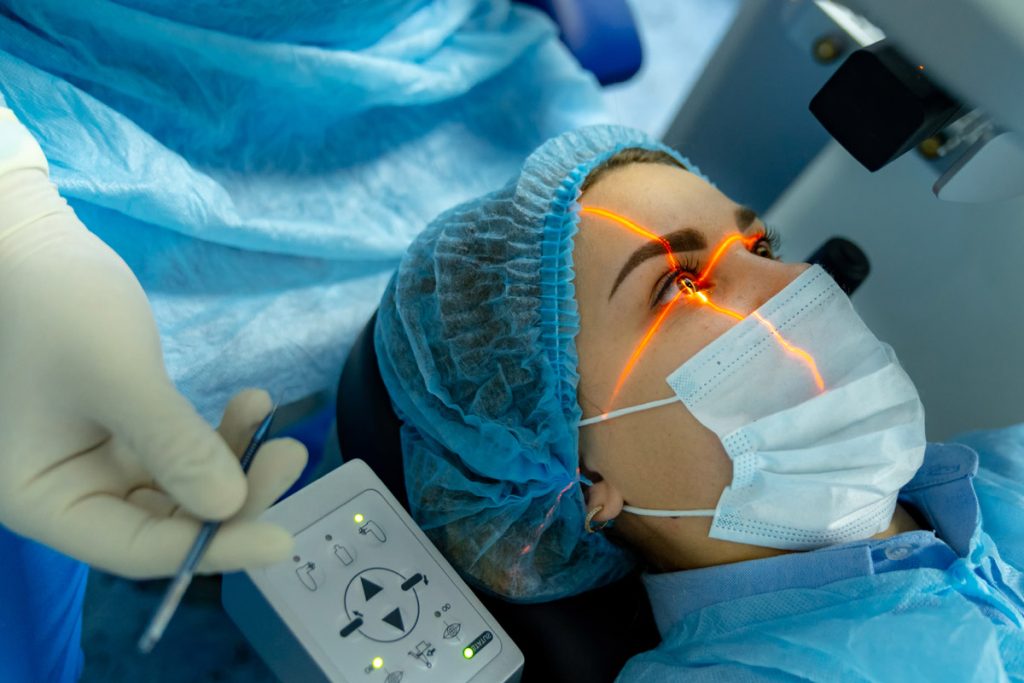
Excimer laser can be applied to the eye by two methods. Treatments in which the outermost epithelial layer of the cornea is removed are called surface ablation (No-touch, PRK, LASEK); the treatment in which a flap is lifted from the deeper layers of the cornea is called LASIK. In LASIK, a femtosecond laser is used to lift what we call the flap.
How is excimer laser applied and how long does it take?
Excimer laser is applied with drop anaesthesia; no pain or discomfort is felt during surgery, and it takes about ten minutes on average.
What should be observed after laser eye surgery?
Since dry eye may occur particularly in the first month after laser surgery, it is advisable to limit screen activity. No eye make-up should be applied for the first week. In addition, it is recommended not to enter the sea or pool during the first month, or to use swimming goggles.
WHO CANNOT HAVE LASER?
At the point we have reached today, we can treat myopia up to 8 dioptres, and hyperopia and astigmatism up to 5 dioptres, with excimer laser. The most important criterion in deciding on excimer laser is that the thickness and structural characteristics of the corneal tissue on which the treatment will be applied are suitable. In addition, our patients must be at least 18 years of age and their prescription must have remained stable for the last year. Patients who wear contact lenses must take a break from lens use for at least 1 week.
Prepared by the Editorial Board of the Eye Foundation Hospitals.