
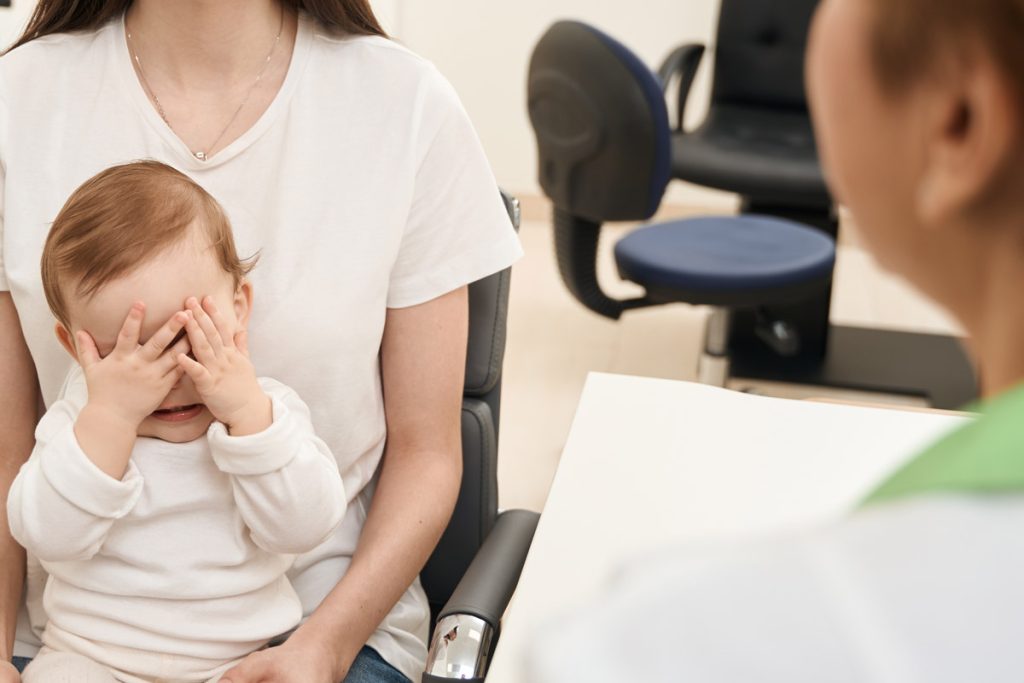
Strabismus is the inability of both eyes to align with each other at the same time. There are 6 extraocular muscles around each eye. When one or more of these muscles is too weak or too strong, the eyes deviate. The two eyes cannot focus on the same object simultaneously. While one eye looks straight ahead, the other may deviate inward, outward, upward or downward. In some cases the deviation is present in both eyes.
Depending on the cause, the deviation may be constant or intermittent. Strabismus occurs in approximately 4% of the population and is equally common in girls and boys.
The six muscles surrounding each eye work “as a team”. This allows both eyes to focus on the same object.
In a person with strabismus, these muscles do not work together. As a result, while one eye looks at an object, the other turns in a different direction and looks at something else.
When this happens, two different images — one from each eye — are sent to the brain. This confuses the brain. In children, the brain may learn to ignore (suppress) the image from the weaker eye.
If strabismus is not treated, the eye whose images are ignored by the brain may never see well. This loss of vision is called amblyopia. Another name for amblyopia is “lazy eye”. Sometimes amblyopia develops first and then causes strabismus.
In most children with strabismus the cause is unknown. In more than half of cases the problem is present at birth or shortly afterwards. This is called congenital strabismus.
The issue is usually one of muscle control rather than muscle strength.
What Are the Symptoms of Strabismus?
- Loss of alignment between the eyes.
- Eye pain
- Double vision
- Blurred vision
- Loss of three-dimensional (depth) perception
- Turning of the head or face to one side
- Chin elevation, tilting the head down and looking up with the eyes
- Closing one eye in bright light or when looking into the distance
- Headache may also be present.
What Are the Symptoms of Strabismus in Adults?
- In strabismus that develops later in life, the most common symptom is double vision.
- Symptoms such as eye pain, headache and a persistently tilted head posture may be present.
- Children and adults with outward eye deviation tend to close one eye in bright sunlight.
What Are the Risk Factors for Strabismus?
- Having a family history of strabismus
- A history of premature birth
- Having had a febrile convulsion at an early age
- Consanguineous marriage in the family
- A history of trauma (falling from a height, hitting the head)
- A problematic pregnancy.
How Is Strabismus Diagnosed and Investigated?
- Assessment of vision. In our hospital, a dedicated paediatric refraction unit (Plus Optix device) is used for children between 6 months and 4 years of age.
- Direction of the deviation and when it began
- Determination of the degree of deviation using prisms and a synoptophore
- Hess screen test: important in strabismus associated with extraocular muscle palsy
- Hirschberg test: assessment of the degree of deviation using the corneal light reflex in patients who cannot fixate
- Stereopsis test: assessment of depth perception (three-dimensional vision).
Early Diagnosis in Childhood
It is very important to have the first eye examination by the age of 6 months at the latest;
- Conditions such as ptosis (drooping eyelid) and nystagmus (involuntary eye movements) can be detected early during this period so that treatment can begin.
- Congenital cataract, congenital glaucoma or disorders of the retina may lead to permanent vision loss within 2–3 months.
- An examination between 6 months and 1 year of age is particularly important for detecting and treating strabismus. Deviations that persist beyond 6 months require treatment without exception.
- Even in the absence of any complaints, examinations at 3–4 years of age and before the start of school are also important.
How Is Strabismus Treated?
- Optical Treatment: Some forms of strabismus are caused by a refractive error and may be corrected with glasses.
- Orthoptic Exercises: Applied to improve binocular vision and depth perception.
- Medical Treatment: Treatment with mydriatic and miotic drops.
- Surgical Treatment: The aim of strabismus surgery is to correct the deviation, restore binocular single vision and achieve a good cosmetic appearance.
It is applied in deviations present from birth or in later-onset deviations that cannot be corrected with glasses.
How Is Strabismus Treated in Adults?
- Eye Exercises: Used in the treatment of conditions such as convergence insufficiency, where the eyes cannot adequately focus while reading or working.
- Prismatic Glasses: Used in the treatment of small deviations. They help reduce double vision.
- Injection (Botulinum toxin): Based on the use of a drug that, when injected, temporarily paralyses the muscle for several months. It is a useful option in selected cases for the non-surgical correction of large-angle deviations present at birth, or for the temporary or permanent resolution of deviations that develop later for various reasons.
- Surgery: The most common form of treatment at any age. It is generally performed under general anaesthesia, although it can be performed under local anaesthesia in cases where general anaesthesia is medically contraindicated. Strabismus surgery may be carried out to improve binocular vision and ocular alignment, restore three-dimensional vision, achieve cosmetic benefit, reduce double vision, enable the use of both eyes together and relieve eye pain.
What Is Amblyopia – Lazy Eye?
Amblyopia, known in everyday language as “lazy eye”, is a 20% or greater reduction in visual acuity in one or both eyes. Its prevalence in the general population is between 2% and 4%.
Vision is a skill that the brain learns from birth onwards. If the transmission of the visual stimulus to the brain is impaired due to a congenital or acquired eye condition (cataract, strabismus, high refractive error, etc.), amblyopia may develop during the infancy and childhood years when vision develops rapidly. Preventing amblyopia and ensuring binocular vision (the use of both eyes together) is critically important during the first two years of life, while the nervous system is still flexible. The earlier treatment is started, the better the outcome. A full eye examination by an ophthalmologist before the age of 1 is essential, especially for those with a family history of amblyopia or strabismus. However, even in the absence of any complaints or risk factors, a routine eye examination by an ophthalmologist is required for everyone by the age of 2 at the latest.
How Is Amblyopia Treated?
Treatment of amblyopia is directed at its cause. Conditions that obstruct vision, such as ptosis or cataract, must be treated first. Other treatment options are, in order:
- Glasses Treatment: Refractive errors, which are a frequent cause of amblyopia, must be corrected with glasses or, where necessary, contact lenses.
- Patching Treatment: Based on the principle of fully or partially patching the better-seeing eye. Recent studies have shown that 6 hours of patching is sufficient in most cases of severe amblyopia in the 3–7 age group, and 2 hours is sufficient in mild-to-moderate amblyopia. Performing near-vision tasks during patching increases the success of treatment. In general, children respond well to patching up to the age of 12.
- Penalisation Treatment: Divided into atropine penalisation and optical penalisation. For this purpose, 1 drop of 1% atropine is instilled in the better-seeing eye every day or 2–3 days a week in the morning. The refractive error of the amblyopic eye is corrected as fully as possible — near vision is enhanced with an additional + lens — while the sound eye is under-corrected.
- CAM Treatment: Performed in a hospital setting in 10 sessions, every day of the week. It is also offered at our hospital. Studies have shown that CAM treatment produces visual outcomes comparable to those of standard patching combined with near-vision tasks.
Up to What Age Should Amblyopia Treatment Continue?
Even when full vision is restored in both eyes following amblyopia treatment, amblyopia may recur after treatment is stopped. For this reason, children with amblyopia should be followed up until the age of 10–12 and should receive maintenance treatment if needed (to preserve vision).
What Is Watery Eye and Tear Duct Obstruction?
The most common cause of watering and discharge from the eye is obstruction or narrowing of the tear ducts. When pressure is applied to the bridge of the nose, inflammatory fluid is expelled through the opening at the eyelid. Within the first year of life this can be distressing for parents; however, the duct usually opens by the end of this period and the child’s complaints subside. During this time, massage of the bridge of the nose is recommended to help the duct open, and antibiotic drops are advised during periods of discharge.
If the duct has still not opened by the end of the first year, a procedure called probing can be performed under general anaesthesia. If unsuccessful on the first attempt, it may be repeated once more. If the duct still does not open, between 2 and 4 years of age a procedure called intubation (tube placement) may be performed. If the problem persists beyond the age of 4–5, delay in treatment may make open surgery necessary.
You can contact our hospital for any questions regarding eye health, obtain detailed information about your eye problems and learn about the treatment process.
Prepared by the Editorial Board of the Eye Foundation Hospitals.