Trust and comfort in eye health;
What Is SMILE Treatment? (Small Incision Lenticule Extraction)
The correction of refractive errors we call myopia, hyperopia and astigmatism through procedures performed on the transparent corneal layer at the very front of the eye has been carried out for more than 50 years.
The aim here is to reshape the cornea — in a sense, to turn it into a spectacle lens — so that the light reaching the eye is focused on the correct point.
This process, which began in the 1970s with RK (Radial Keratotomy), was taken to a different dimension in 1989 with the introduction of the Excimer Laser, and it spread worldwide. In 1991, the LASIK technique was developed, in which a flap is lifted from the cornea and the Excimer Laser is applied to the deeper layers of the cornea. This shortened the recovery period, reduced the post-operative discomfort and made refractive results more stable. By 2005, femtosecond lasers replaced blade systems in the lifting of the corneal flap in the LASIK technique. With these lasers — capable of creating incisions in the cornea at the desired depth and shape — the LASIK procedure became safer, and the method was named FemtoLASIK.
It is the latest-technology laser eye-surgery method used in the treatment of refractive errors such as myopia, hyperopia and astigmatism.
The latest development in corneal refractive correction is the SMILE technique, developed by Zeiss.
How Is the SMILE Laser Applied?
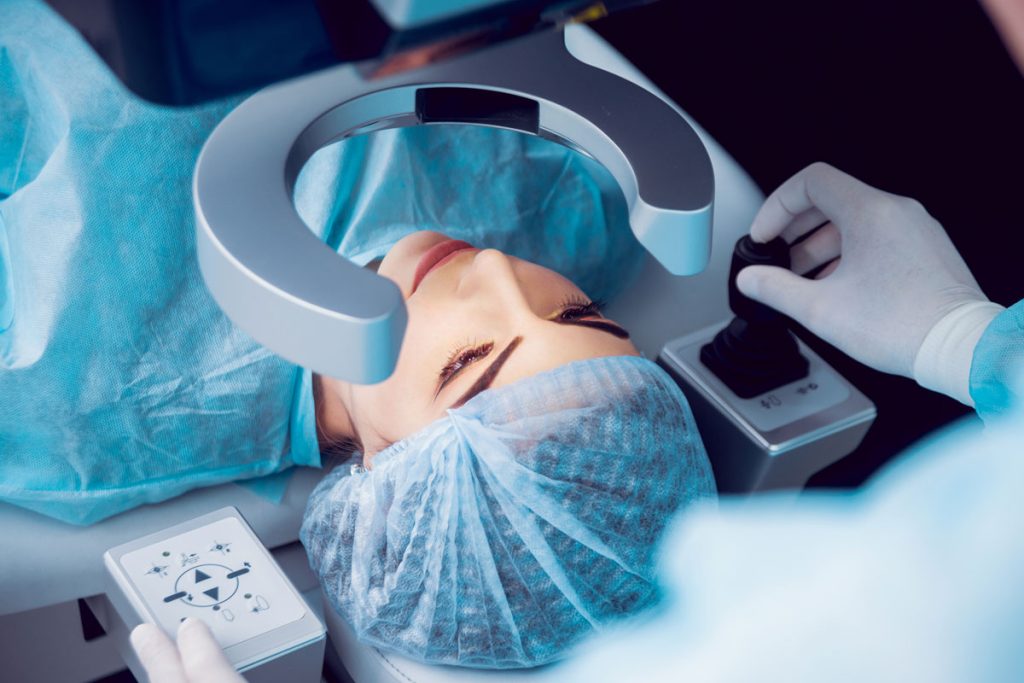
Using a femtosecond laser, the procedure is performed through a small incision of 2–4 mm, without lifting a flap.
Compared with FemtoLASIK, this surgery is performed more quickly because only one device is used, and recovery is very rapid. Corneal biomechanics are better preserved, and because the nerves are less damaged, dry eye is less common.
In 2024, Zeiss further developed the Visumax device — used for SMILE treatment — and launched the Visumax Pro. With this device, the treatment time has been reduced to under 10 seconds, the correction of astigmatism has become more successful thanks to the eye-tracking system, and hyperopia treatments — previously not possible — have been added to the portfolio. With the Visumax Pro, myopia up to 10 dioptres, and hyperopia and astigmatism up to 5 dioptres, can now be treated.
In conclusion, with SMILE treatment — which we can describe as the 3rd-generation corneal refractive surgery — being free of glasses in suitable patients has become safer and more comfortable.
Comparison of SMILE, LASIK and PRK
|
Feature |
PRK (1980s) |
LASIK (1990s) |
SMILE (2010s) |
|
Surgical Technique |
Epithelium is removed, laser is applied |
Flap is lifted, laser is applied |
Lenticule extracted through a small incision |
|
Incision Size |
None (surface) |
Around 20 mm |
Only 2–4 mm |
|
Recovery Time |
Long (2–4 weeks) |
Medium (1–2 days) |
Short (returns to normal within 1 day) |
|
Pain / Discomfort |
Moderate–High |
Low |
Very low |
|
Risk of Dry Eye |
Moderate |
Higher |
Lower (nerves are preserved) |
|
Corneal Durability |
High |
Medium |
High (biomechanical structure better preserved) |
|
Technology |
The oldest |
Widespread and reliable |
The newest and most advanced |
|
Suitable Patient Profile |
Thin corneas, athletes, etc. |
Generally most people |
Thin corneas, those with an active lifestyle |
Dr. Ali Sipahier
Eye Foundation Bayrampaşa Eye Hospital
Prepared by the Editorial Board of the Eye Foundation Hospitals.